
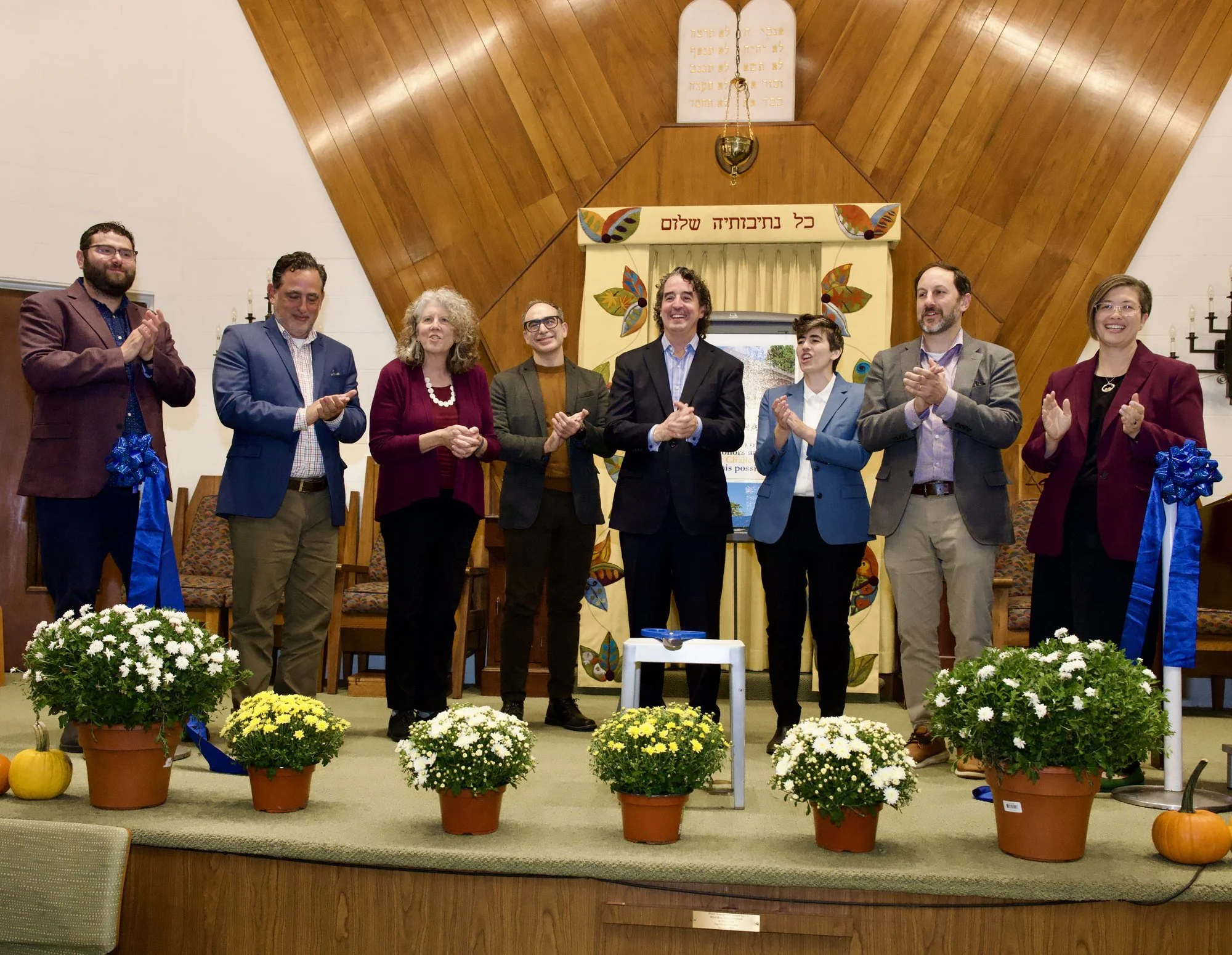
Full description: Eight people stand in a row on the raised bimah at the front of the sanctuary, all smiling and applauding right after the ribbon was cut. Behind them rises the sanctuary’s tall, peaked wall of warm honey-colored wood. At its top are the two tablets of the Ten Commandments, and just below them hangs the brass eternal light. The ark is covered by a pale yellow curtain decorated with colorful fabric leaves, and above it runs the Hebrew verse Kol n’tivoteha shalom, “all her paths are peace.” From left to right: Noah Weinberg in a plum jacket and glasses; Michael Kadish in a blue blazer and checked shirt; Rabbi Emerita Barbara Penzner in a plum sweater and a white bead necklace; co-president Mark Wilen in glasses, a dark jacket and a rust-colored sweater; Jason Arenburg in a dark suit, laughing; Rabbi Aliza Schwartz in a light blue blazer and white shirt; Councilor Benjamin Weber in a gray jacket; and Persis Yu in a plum blazer. The two cut halves of the royal blue ribbon hang from white posts at either end, each topped with a big blue bow. Along the front edge of the bimah sit pots of white and yellow mums and a few small pumpkins.
Gather & Glow Sukkot, Solar & Supper
We Built This From Love: Our Solar Roof Celebration
Erev Sukkot 5787
For screen reader users: each photo on this page is followed by a full description.
Before anyone said a word about kilowatts or grants, the HBT band had us singing. They opened with “Olam Chesed Yibaneh,” Rabbi Menachem Creditor’s setting of Psalm 89:3, and its refrain kept coming back: I will build this world from love. By the end of the night, that line described exactly what we had done.
We gathered on Erev Sukkot, as Shabbat and the festival arrived together, to celebrate a new roof and the 126 solar panels on top of it. A nor’easter moved the whole evening indoors, which only sharpened the point. On a holiday about shelter, we sat under a roof that now shelters us and, soon, will power us too.
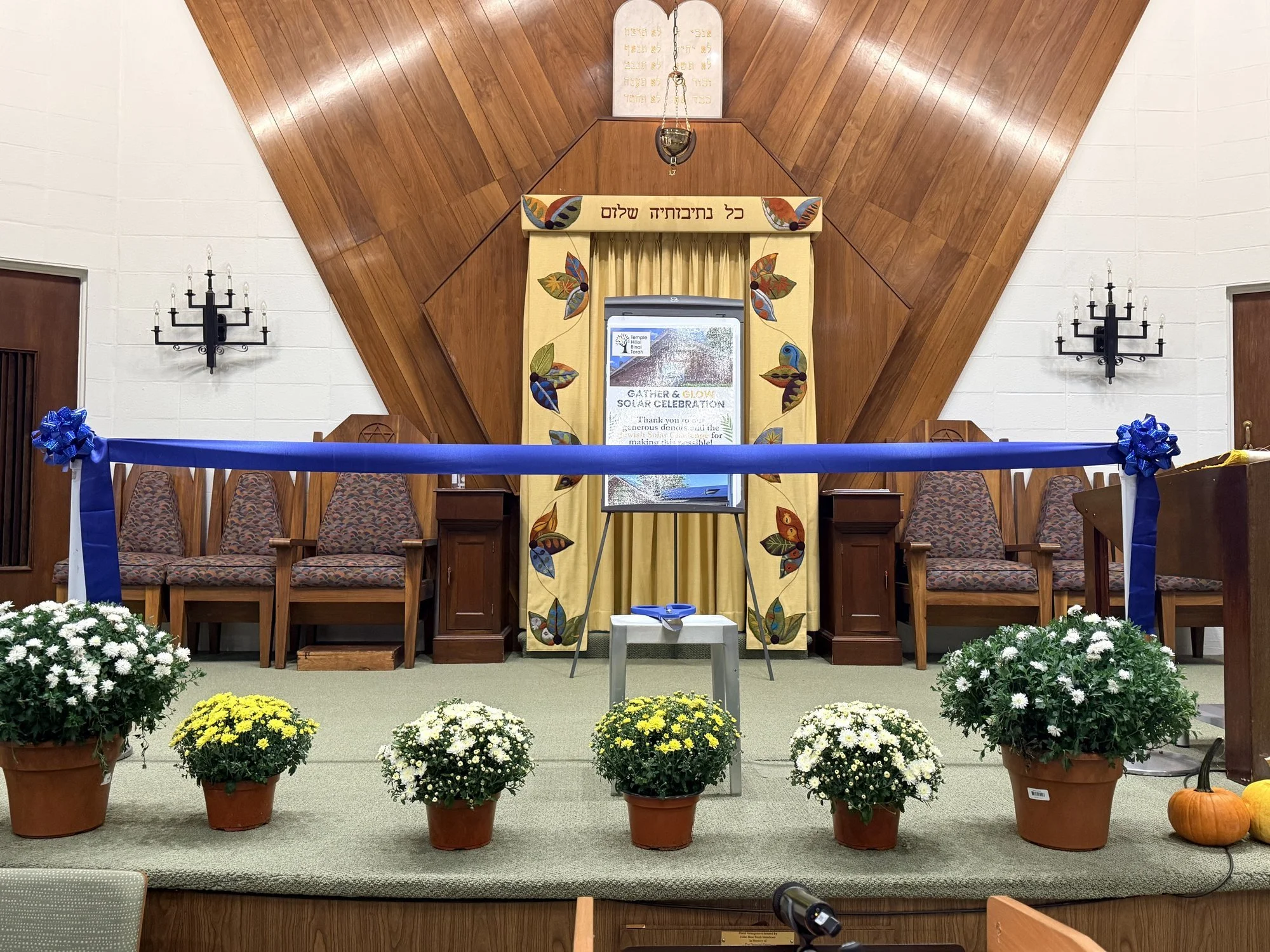
Full description: Before anyone arrived, the bimah is set for the ceremony. A royal blue ribbon stretches across the front of the bimah between two white posts, each topped with a big blue bow. Behind it, a pair of scissors with blue handles waits on a small white stool, in front of the “Gather and Glow Solar Celebration” sign on an easel. Behind that rise the pale yellow ark curtain with its colorful fabric leaves, the Hebrew verse “all her paths are peace,” the brass eternal light and the tablets of the Ten Commandments at the top of the tall wooden wall. Along the front edge, pots of white and yellow mums alternate, with small pumpkins at the right.
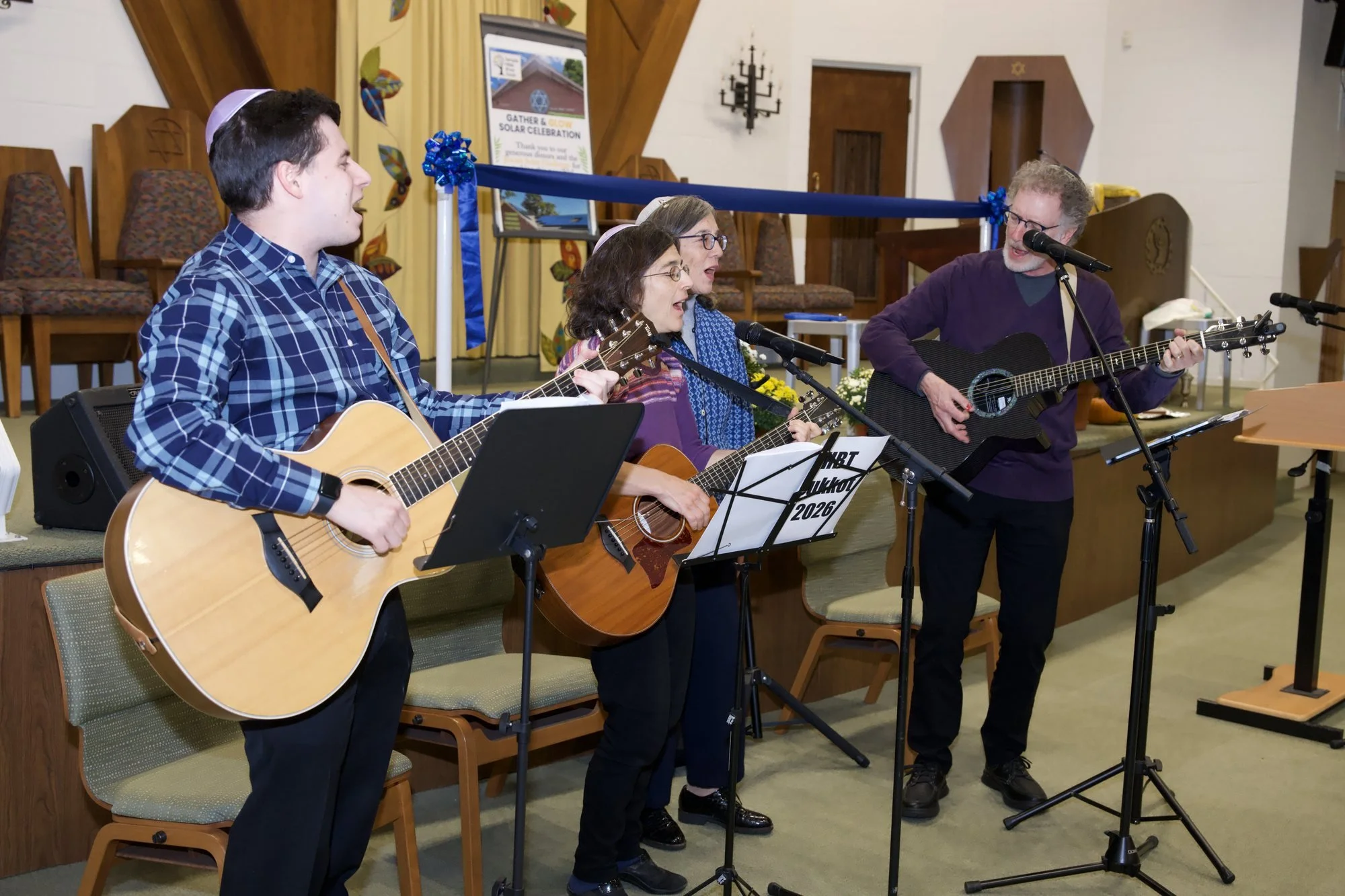
Full description: The HBT band stands in front of the bimah singing into microphones. From right: Cantor Jeff Klepper, who leads the band, playing guitar; Susannah Sirkin, in glasses and a blue checked shirt, singing; Sharin Horvitz-Chung, playing guitar just in front of her; and Noah Simon on the left in a blue plaid shirt, playing guitar. A music stand holds a sign reading “HBT Sukkot 2026.” Behind them the blue ribbon is already stretched across the bimah.
You did this, HBT
Co-president Jason Arenburg championed this project from the start, and he told its story plainly. Our roof urgently needed repair. We didn’t have the money to replace it. We bought all our power, and an oil furnace heated our offices and classrooms. The idea was to fix the roof, make our own electricity from the sun, and use heat pumps to heat and cool the classroom and office building.
Then the community stepped up. Eighty-nine individuals and families gave $60,000. The Jewish Solar Challenge, a project of the Schwartz-Rosman Foundation, added a $40,000 matching grant. Together, that grew the plan from 97 panels to 126. Jason got choked up as he said it again and again: “You did this, HBT.”
- 126solar panels on our new roof
- 89individuals and families gave $60,000
- $40,000matching grant from the Jewish Solar Challenge
- 54.8 kilowattssystem capacity
- 63,640 kilowatt-hoursexpected clean power each year
- About 30 tonsof CO₂ avoided each year (estimate)
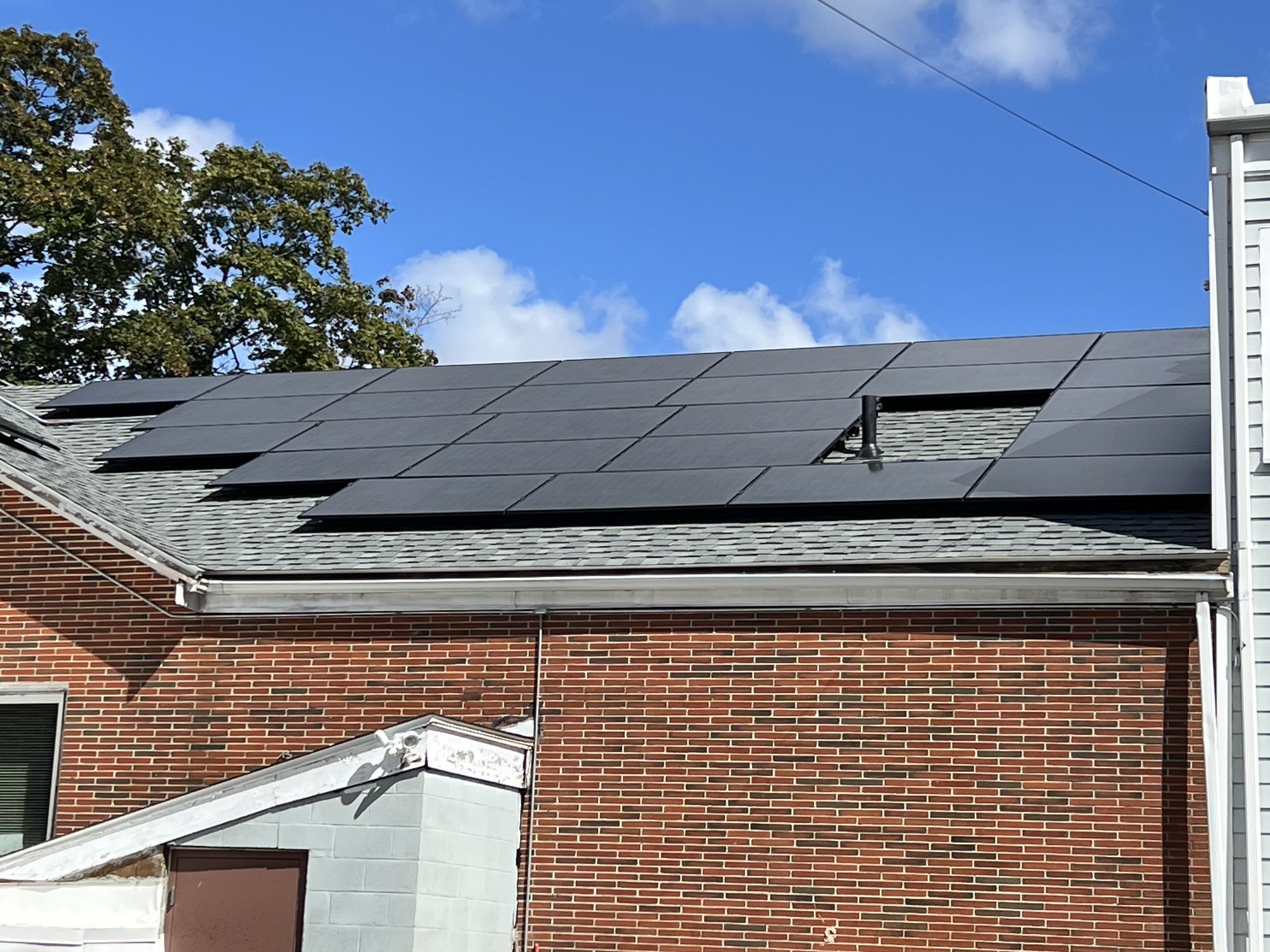
Full description: A sunny day with a bright blue sky and a few puffy white clouds. The gray shingled roof of HBT’s red-brick building is covered with rows of dark, almost black solar panels, set in a slightly staggered pattern. A small vent pipe pokes up in a gap between panels. A leafy tree rises at the upper left, and the white clapboard corner of the neighboring building is at the right edge.
Where things stand. On the night of the ceremony, the panels were installed and waiting for permission to operate, with the city inspection scheduled for the following Monday. The production and carbon figures above are projections; we use “about 30 tons of CO₂ a year” until we have a full year of real numbers. The heat pumps serve our classroom and office building. The sanctuary isn’t electrified yet, and the array is expected to cover nearly all of our annual electricity use.
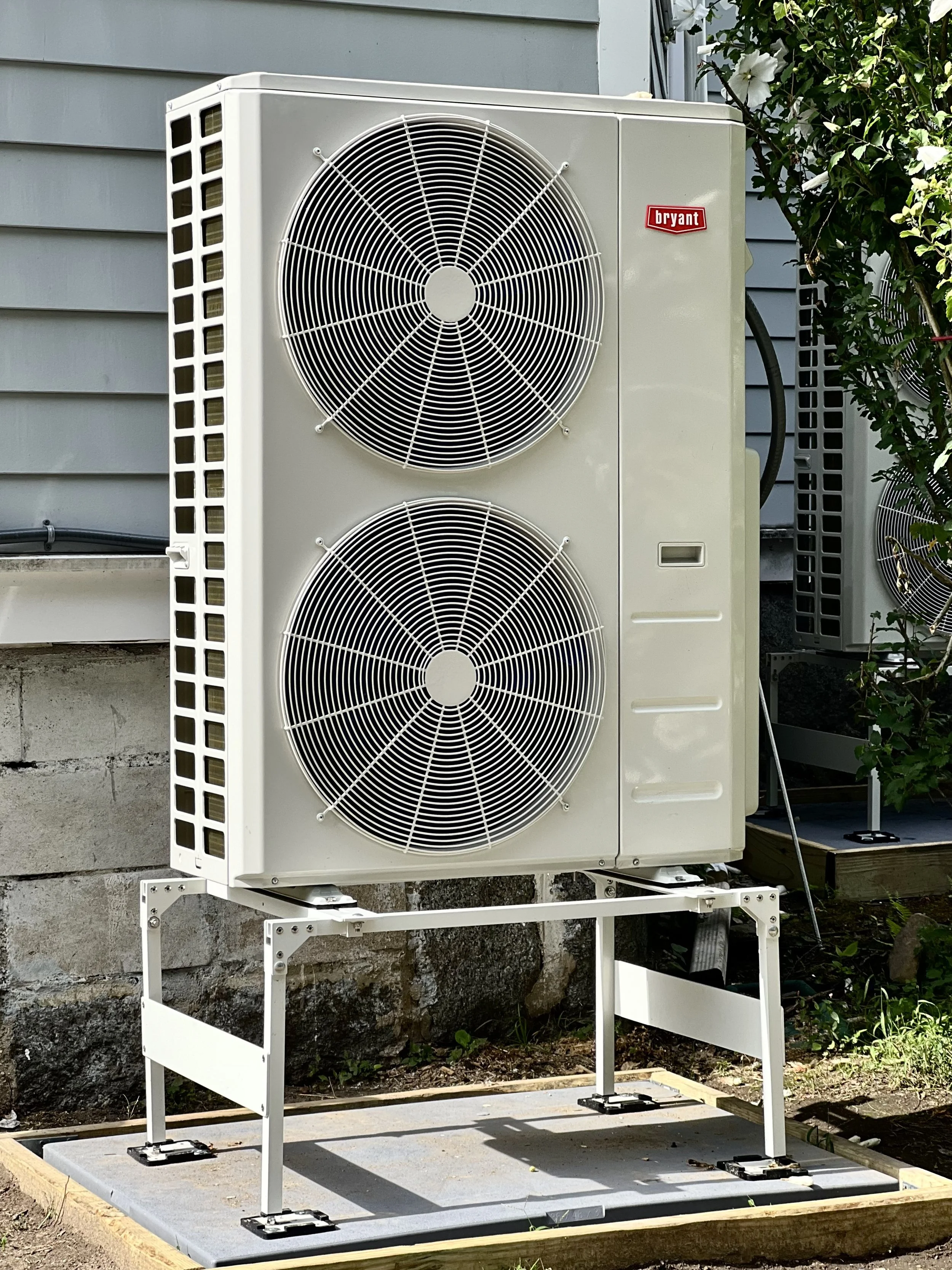
Full description: A tall white outdoor heat pump unit with two large round fans stacked one above the other, each behind a white wire grille. It stands on a white metal frame raised above a gray pad set in a wooden border, next to the building’s gray siding and a low stone foundation. A second unit is partly visible behind it, and green leaves and white flowers from a shrub hang in at the right.
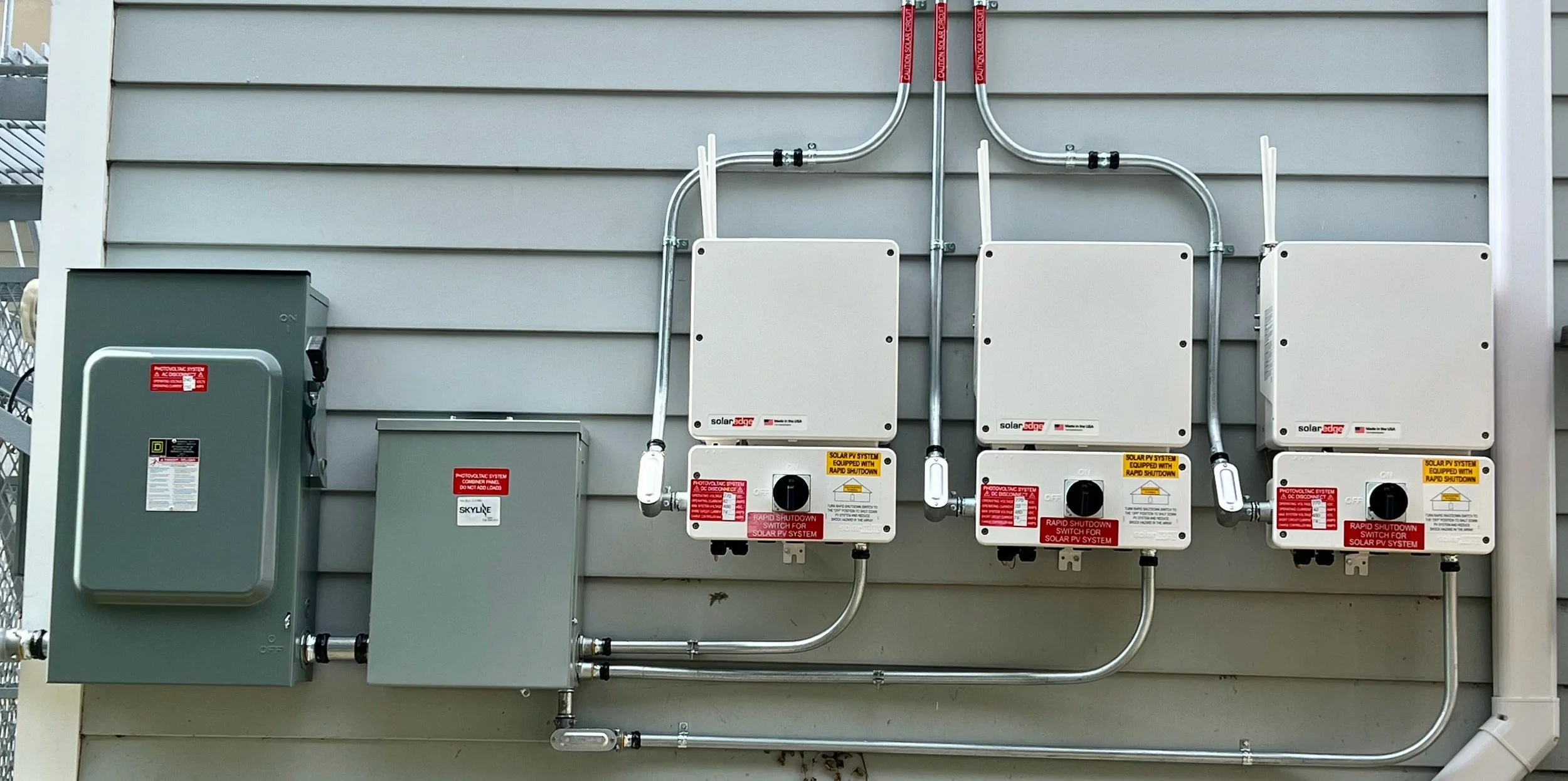
Full description: The outside wall of the building, with gray siding, holding the equipment that brings solar power inside. On the left are two gray metal electrical boxes marked with red safety labels. To the right, three matching white boxes, the solar inverters, hang in a row, each with a round black switch and red and yellow warning labels. Silver metal pipes, carrying the wiring, run neatly up from each box toward the roof and across the wall between them.
What we heard
Nobody coordinated their remarks, but our speakers kept returning to the same few ideas: the sukkah and the roof, what the sun means, and tikkun olam you can actually see. Beneath them all ran one more: this was Temple Hillel B’nai Torah’s doing. Our community gave, planned and built it together, becoming a role model for the wider Jewish community.
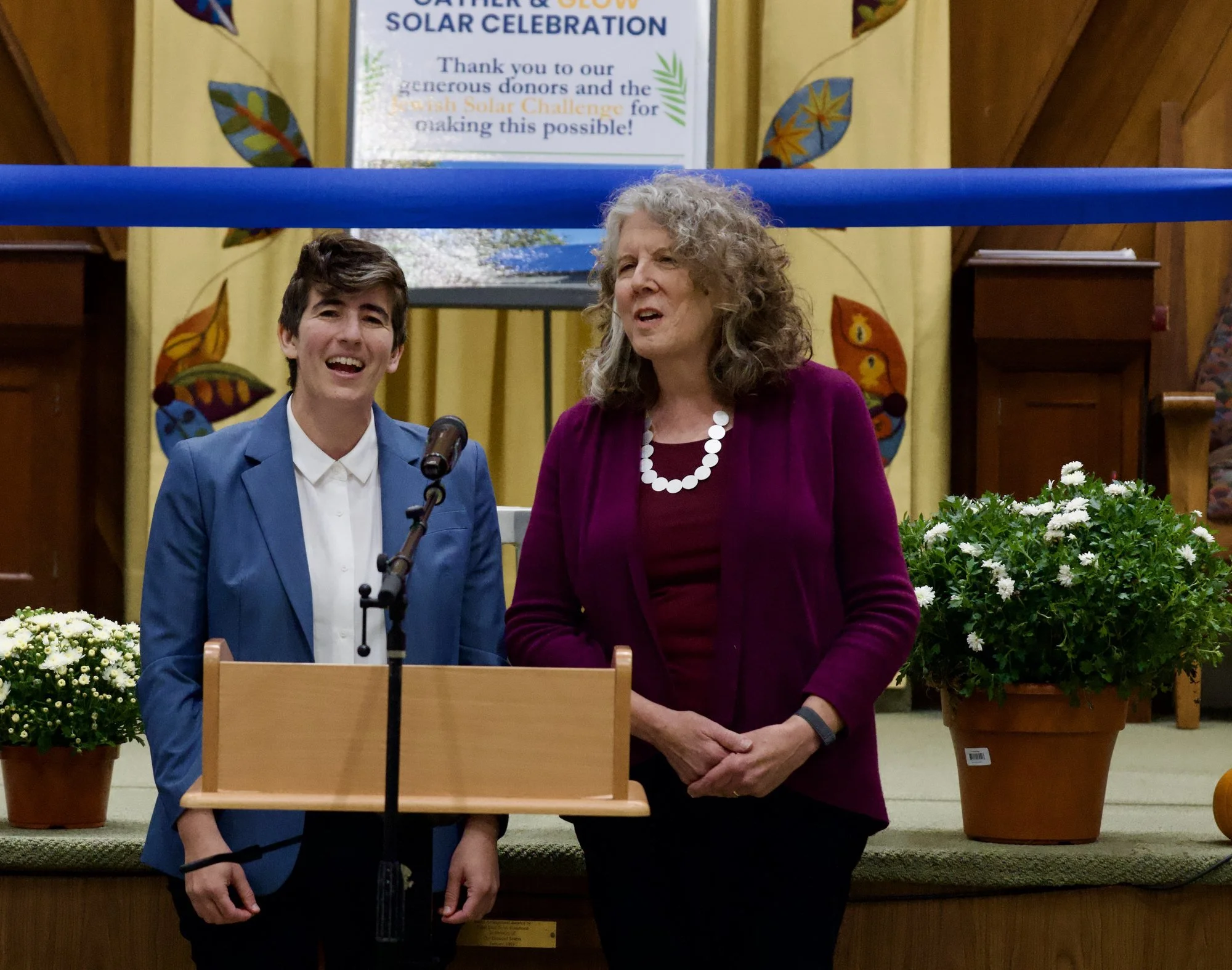
Full description: Rabbi Aliza Schwartz and Rabbi Emerita Barbara Penzner stand side by side behind a light wooden lectern, singing together into one microphone. Rabbi Aliza, on the left, has short dark hair and wears a light blue blazer over a white shirt, and is smiling broadly mid-song. Rabbi Barbara, on the right, has shoulder-length curly gray hair and wears a plum sweater with a white bead necklace, hands folded in front of her. Behind them are the blue ribbon, the yellow ark curtain with its fabric leaves, and part of the “Gather and Glow” sign thanking donors and the Jewish Solar Challenge.
Rabbi Aliza Schwartz, with Rabbi Emerita Barbara Penzner
Rabbi, Temple Hillel B’nai Torah
Rabbi Aliza began with being in “right relationship” with the sun and the world, drawing on the creation story and Jewish teaching about land and trees. She named tikkun olam as one of our four pillars and said our building itself now embodies that work. Then she and Rabbi Emerita Barbara Penzner led Ufros aleinu sukkat shlomecha, a prayer for a shelter of peace. For a week we live in a fragile sukkah; then we come home to this building, under our new roof.
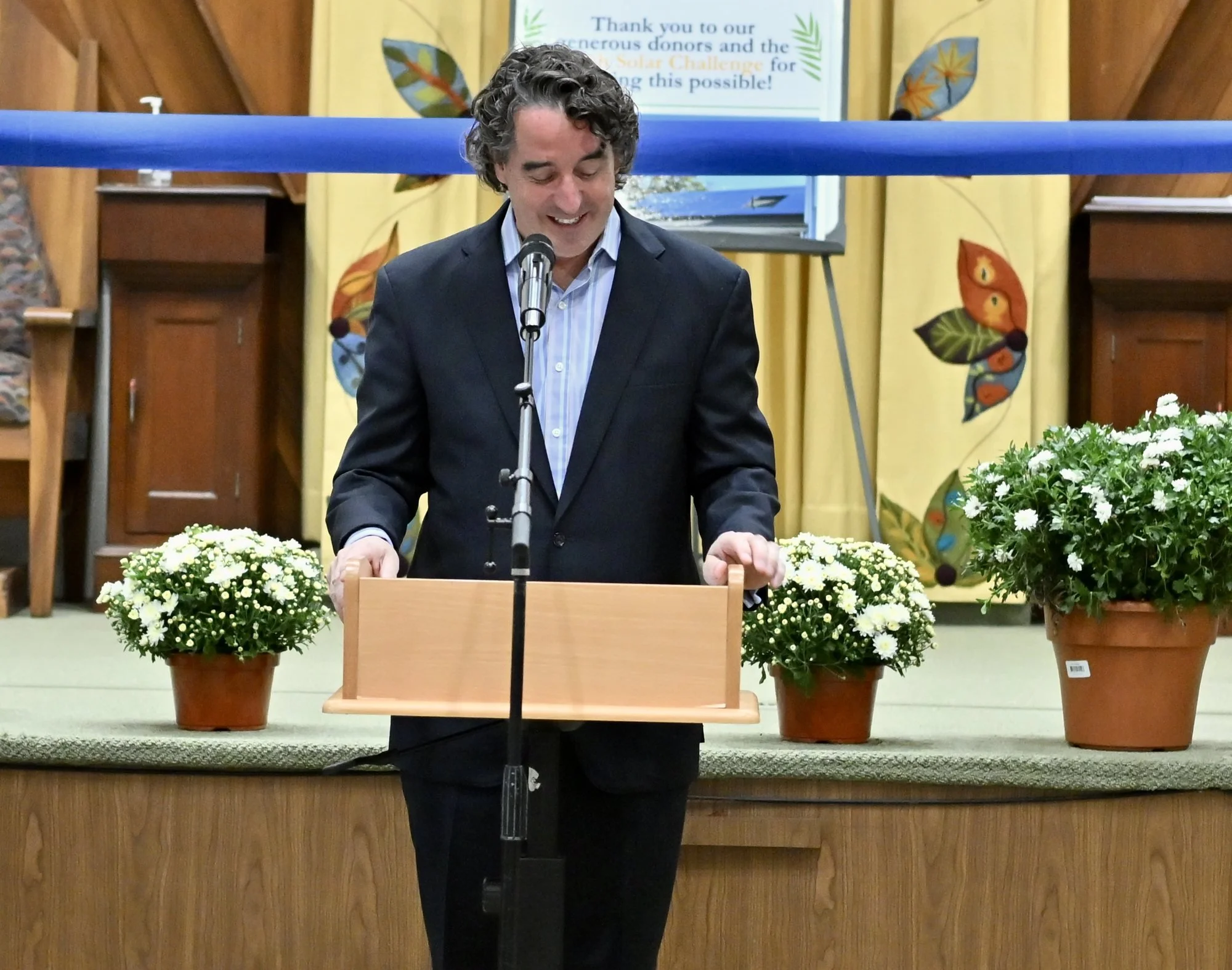
Full description: Jason Arenburg stands at a light wooden lectern, looking down at his notes and smiling. He has dark curly hair and wears a dark suit over a light blue striped shirt, with both hands resting on the lectern. Pots of white mums sit on either side of him, and behind him are the blue ribbon, the yellow ark curtain with its fabric leaves, and the sign thanking donors and the Jewish Solar Challenge.
Jason Arenburg
HBT Co-President
Jason welcomed us to three occasions in one room: Shabbat, Erev Sukkot, and the celebration of 126 solar panels on our roof. He asked us to look up at the panels, particularly on sunny spring days, and feel proud of our contribution. He explained that the original plan was to install 97 panels, but the support from the Jewish Solar Challenge enabled us to expand it to 126 panels.
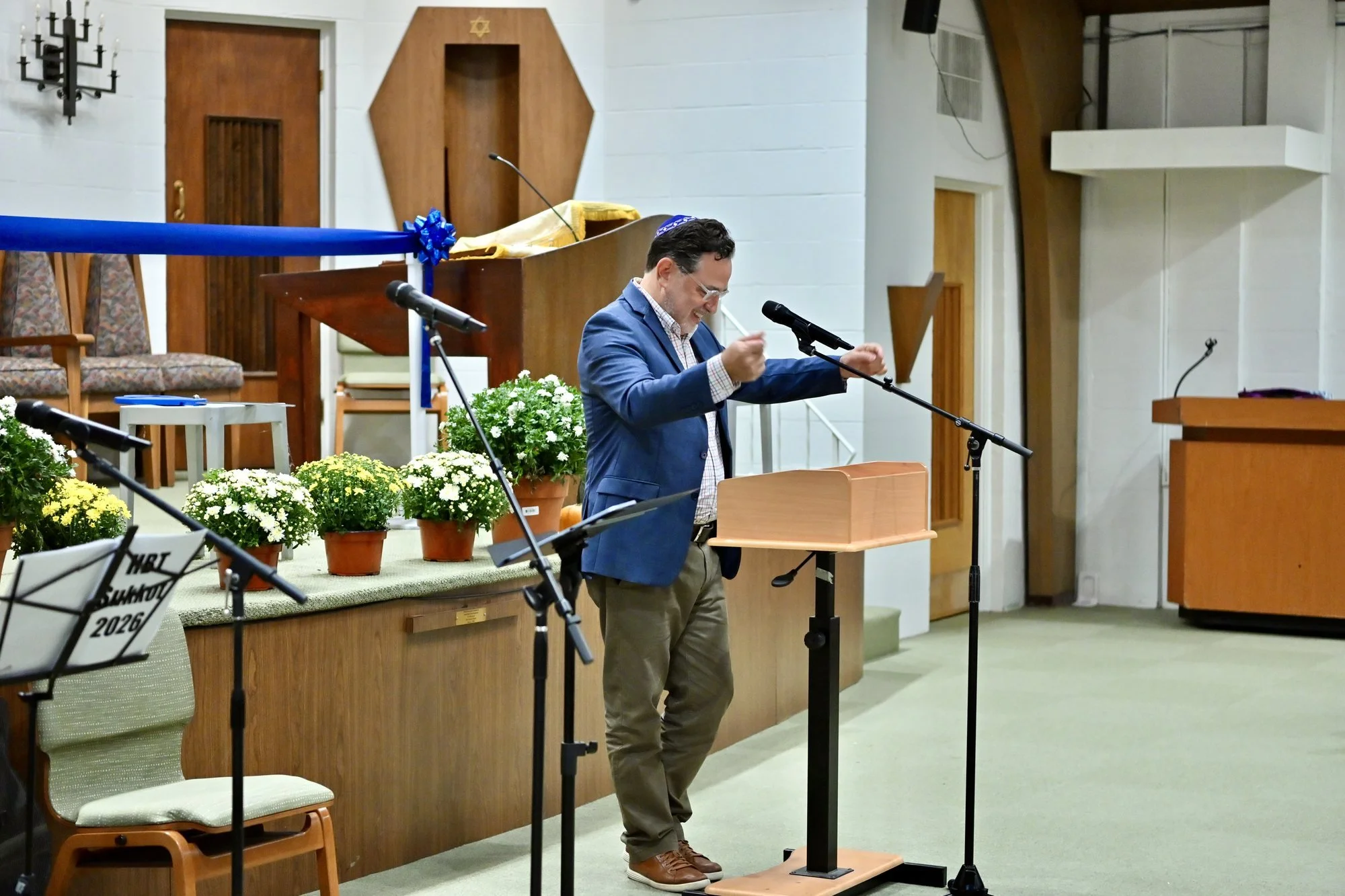
Full description: Michael Kadish stands at a lectern set on the floor to the side of the bimah, caught in an animated moment: both arms stretched forward over the lectern, hands closed, as if acting out part of his story. He wears a kippah, glasses, a blue blazer over a checked shirt, khaki pants and brown shoes. Microphone stands surround him, and to his left the edge of the bimah is lined with pots of white and yellow mums, with the blue ribbon stretched above.
Michael Kadish
Jewish Solar Challenge
Michael shared the Jewish Solar Challenge’s hope to see every Jewish institution in North America powered by the sun: synagogues, JCCs, camps and schools. He pointed out that anyone in our parking lot, including every child, can now see our values on the roof.
“We hope that what you’ve done inspires other institutions around Boston and the country to follow your lead.”
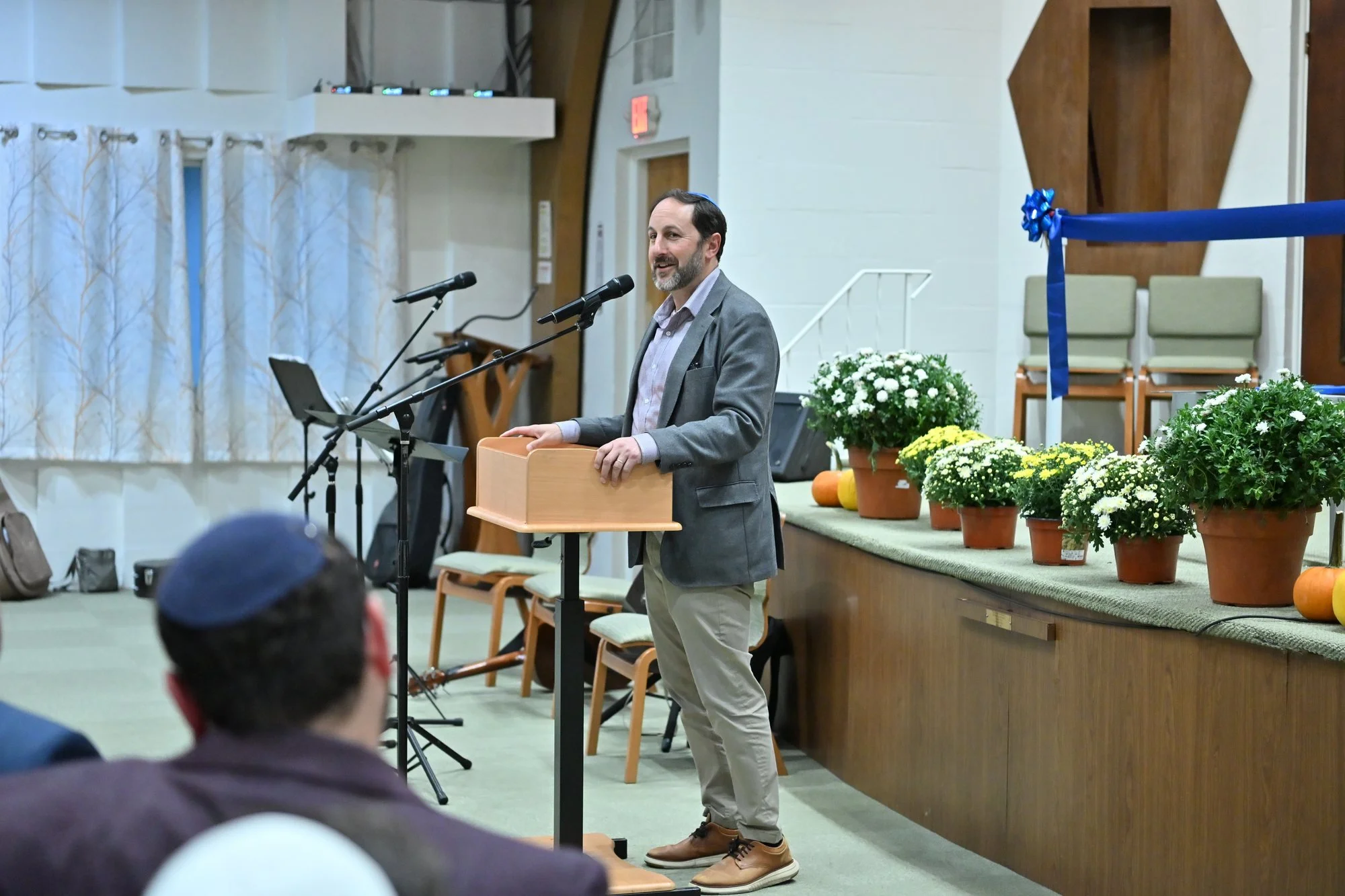
Full description: Seen from the side, Councilor Benjamin Weber stands at the lectern beside the bimah, speaking into a microphone with a slight smile. He has a trimmed beard and wears a kippah, a gray jacket over a lavender shirt, khaki pants and brown shoes. Beside him the bimah’s edge is lined with pots of white and yellow mums and small orange pumpkins. In the foreground, slightly out of focus, is the back of a listener’s head in a blue kippah.
Councilor Benjamin Weber
Boston City Council
Councilor Weber turned to Deuteronomy 20:19, which forbids cutting down fruit trees during a siege, and called trees “nature’s solar panels.” Jason agreed he had “stuck the landing.” Then Sukkot’s temporary shelter led him somewhere harder: Boston children without stable housing. He cited a recent City Council hearing and his figure of about 5,000 Boston Public Schools students who experience homelessness in a year.
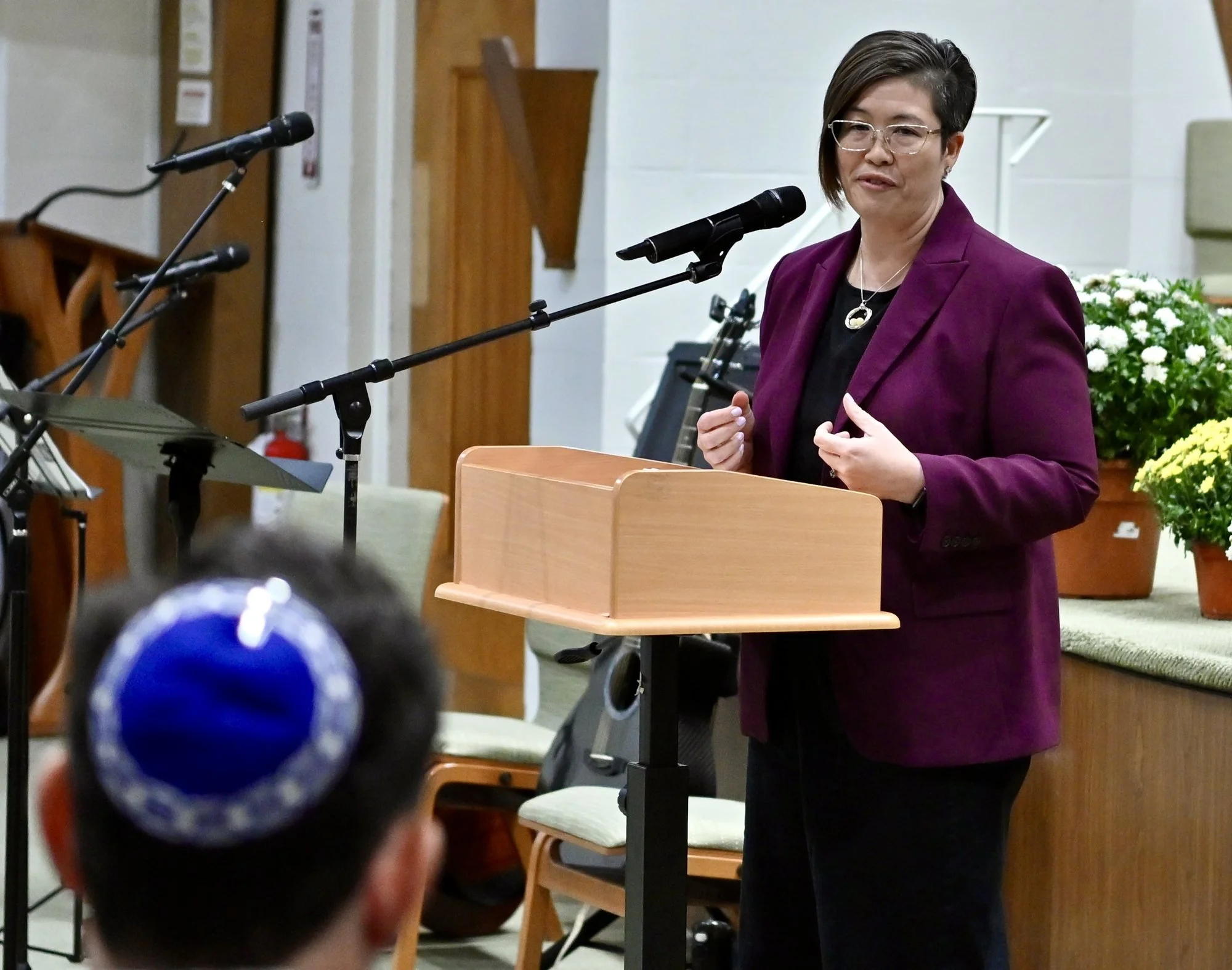
Full description: Persis Yu speaks at the lectern, gesturing with both hands, her expression warm and engaged. She has short dark hair swept to one side and wears glasses, a plum blazer over a black top, and a gold pendant necklace. Microphone stands and a guitar are behind her, with pots of white and yellow mums at the right. In the foreground, out of focus, is the back of a listener’s head in a blue and white kippah.
Persis Yu
Democratic nominee for the Massachusetts Senate (Norfolk and Suffolk District)
Persis Yu was candid that this is a hard moment for clean energy, with public support for solar and wind shrinking and Boston facing a warming climate and rising seas.
“The solve for everything is community. It is community engagement, it is community action, people coming together.”
She thanked HBT “for being a literal light in the dark times.”
Temple Hillel B’nai Torah is a 501(c)(3) nonprofit and does not support or oppose any candidate for public office. Guest speakers’ remarks are their own.
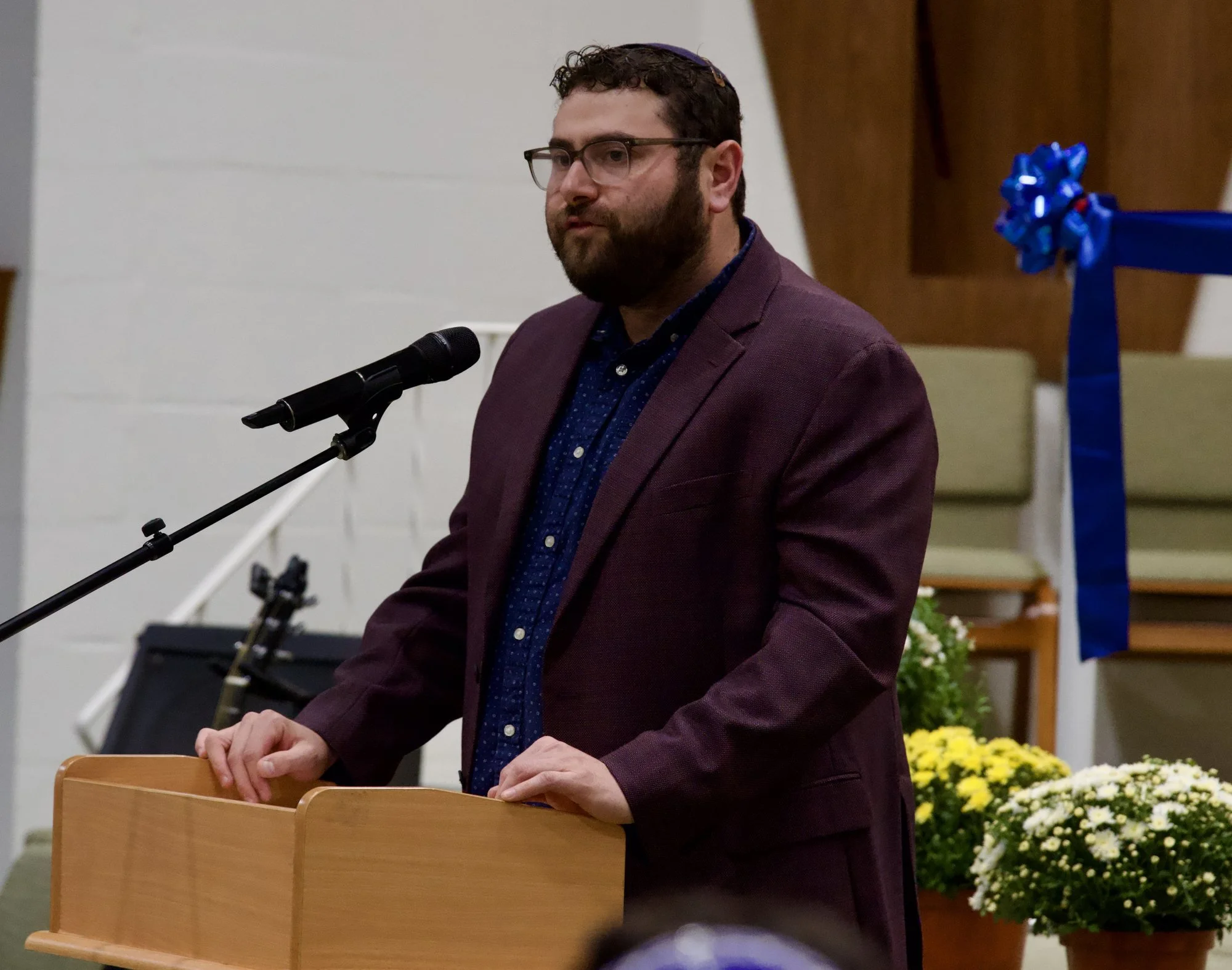
Full description: Noah Weinberg stands at the lectern speaking into a microphone, both hands resting on the lectern. He has dark curly hair, a full beard and glasses, and wears a kippah, a plum jacket and a dark blue patterned shirt. Behind him to the right are one of the ribbon’s big blue bows and pots of yellow and white mums.
Noah Weinberg
Founding Director, Adamah Boston
Many of us know Noah as the musical prayer leader at TBZ in Brookline, and he’s a longtime friend of Rabbi Aliza. He came to us as the founding director of Adamah’s new Boston hub, and, as he told us himself, a farmer: for the last ten years he farmed at Gann Academy in Waltham.
Noah welcomed HBT into Adamah’s Jewish Climate Leadership Coalition and brought us back to Sukkot: z’man simchateinu, the season of our joy, and chag ha’asif, the festival of ingathering. Now we can harvest the sunlight that has always fallen on our building. But a sukkah lets the wind through, and from a decade of farming he described drought, flood, heat waves and surprise frosts. His hope: Jewish communities that are joyful, resilient, and deeply connected to the earth and to one another. At dinner, he hosted a table on earth-based Judaism and local plants.
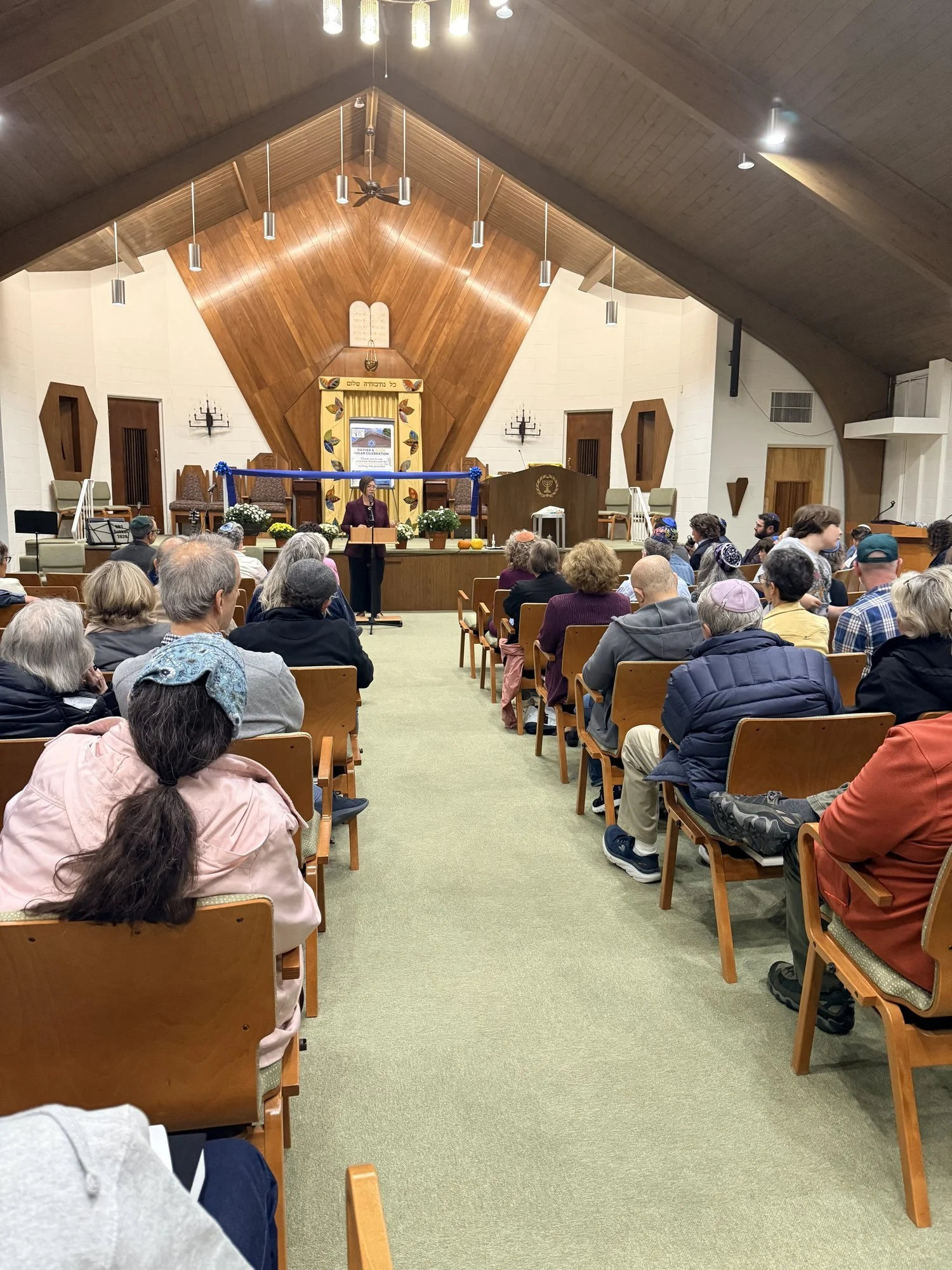
Full description: A tall view from the back of the sanctuary, looking down the center aisle toward the bimah. Both sides of the aisle are filled with people seated in rows of wooden chairs, seen from behind, many wearing kippot, and a few more stand along the right wall. Far ahead, Persis Yu speaks at the lectern in a plum blazer, in front of the blue ribbon and the yellow ark curtain. Above, the dark wooden ceiling rises to a high peak with pendant lights hanging down, and the tall wooden wall behind the ark climbs to the tablets of the Ten Commandments.
The ribbon, then Shabbat
Jason called the speakers and Rabbi Barbara up to the bimah. There was a count-in, a call for a backbeat, and the whole room clapping as the band led “Let the Sunshine In,” then “Siman Tov u’Mazel Tov.” The ribbon was cut with all of us singing.
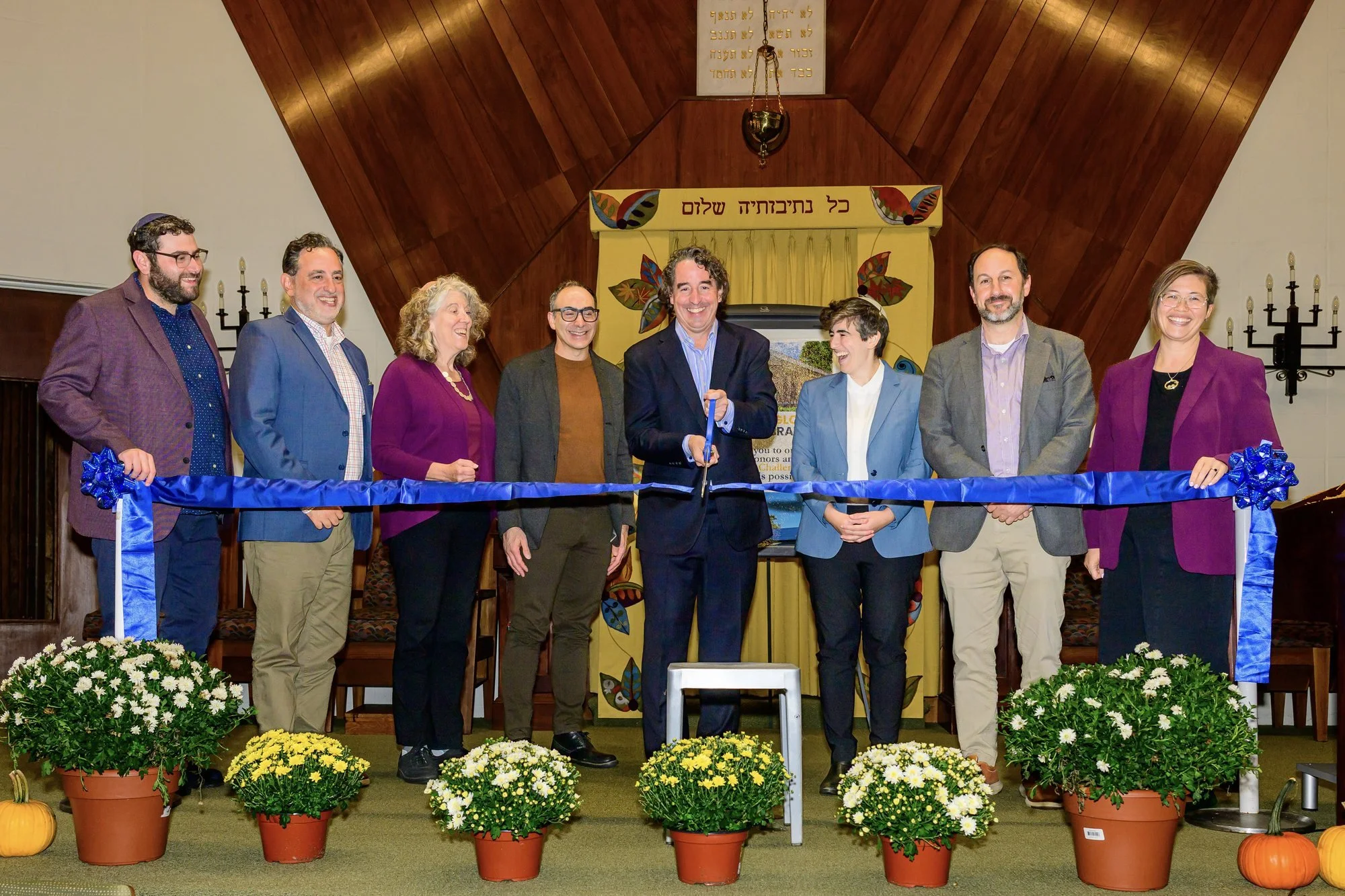
Full description: The same eight people stand in a row on the bimah, the long royal blue ribbon stretched tight across all of them at waist height. In the center, Jason Arenburg holds a large pair of scissors to the ribbon, mid-cut, smiling. The others hold the ribbon and smile and laugh as they watch. From left: Noah Weinberg, Michael Kadish, Rabbi Emerita Barbara Penzner, Mark Wilen, Jason, Rabbi Aliza Schwartz, Councilor Benjamin Weber and Persis Yu. Big blue bows sit at each end of the ribbon, and pots of white and yellow mums line the front of the stage.
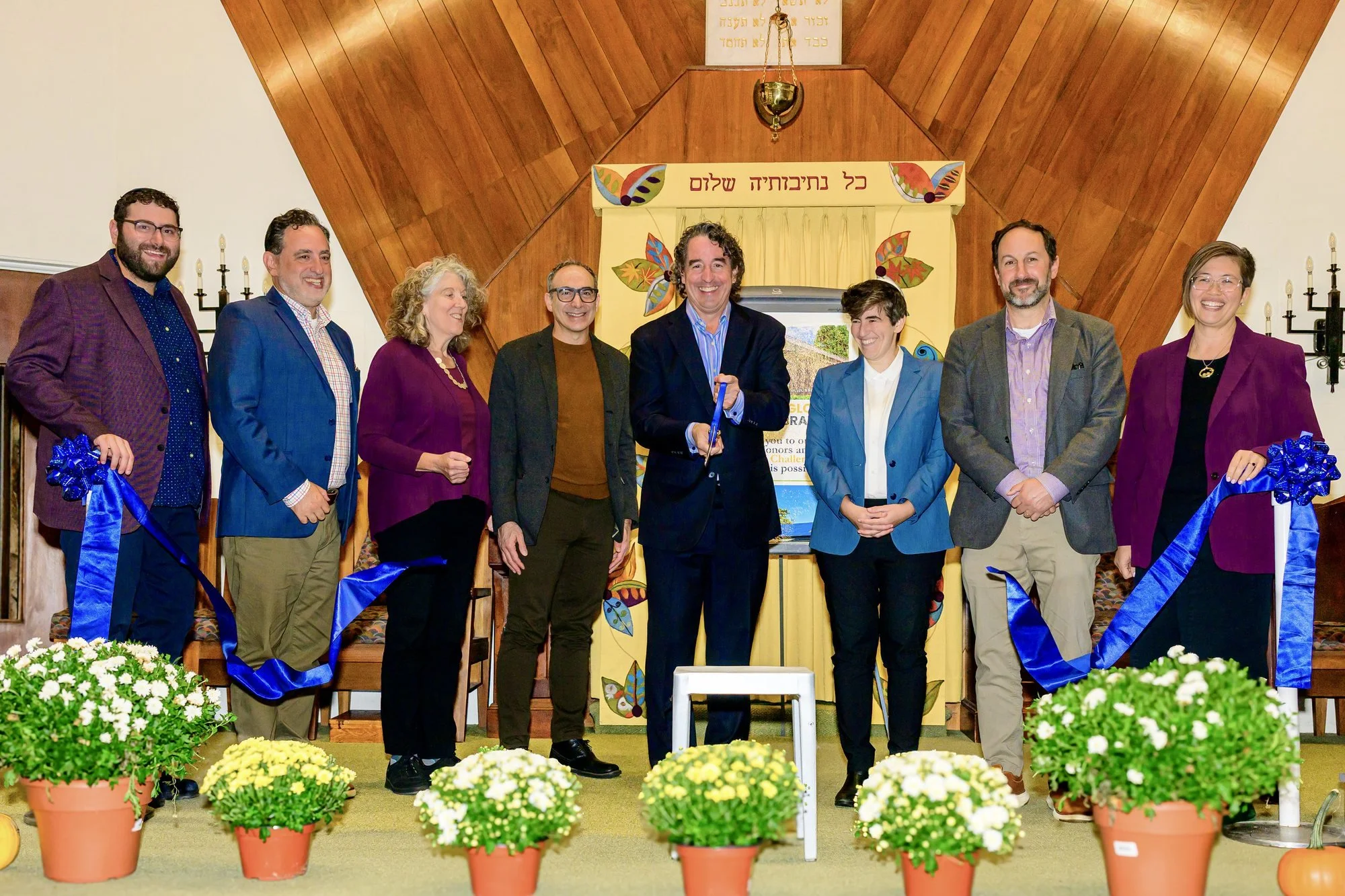
Full description: A moment after the ribbon was cut. The same eight people stand in a row, now beaming, several laughing. Jason Arenburg in the center still holds the scissors. The two halves of the blue ribbon hang loose, swooping down from the bows at each end toward the floor. The mums, pumpkins and the tall wooden wall behind them are the same as in the photo before.
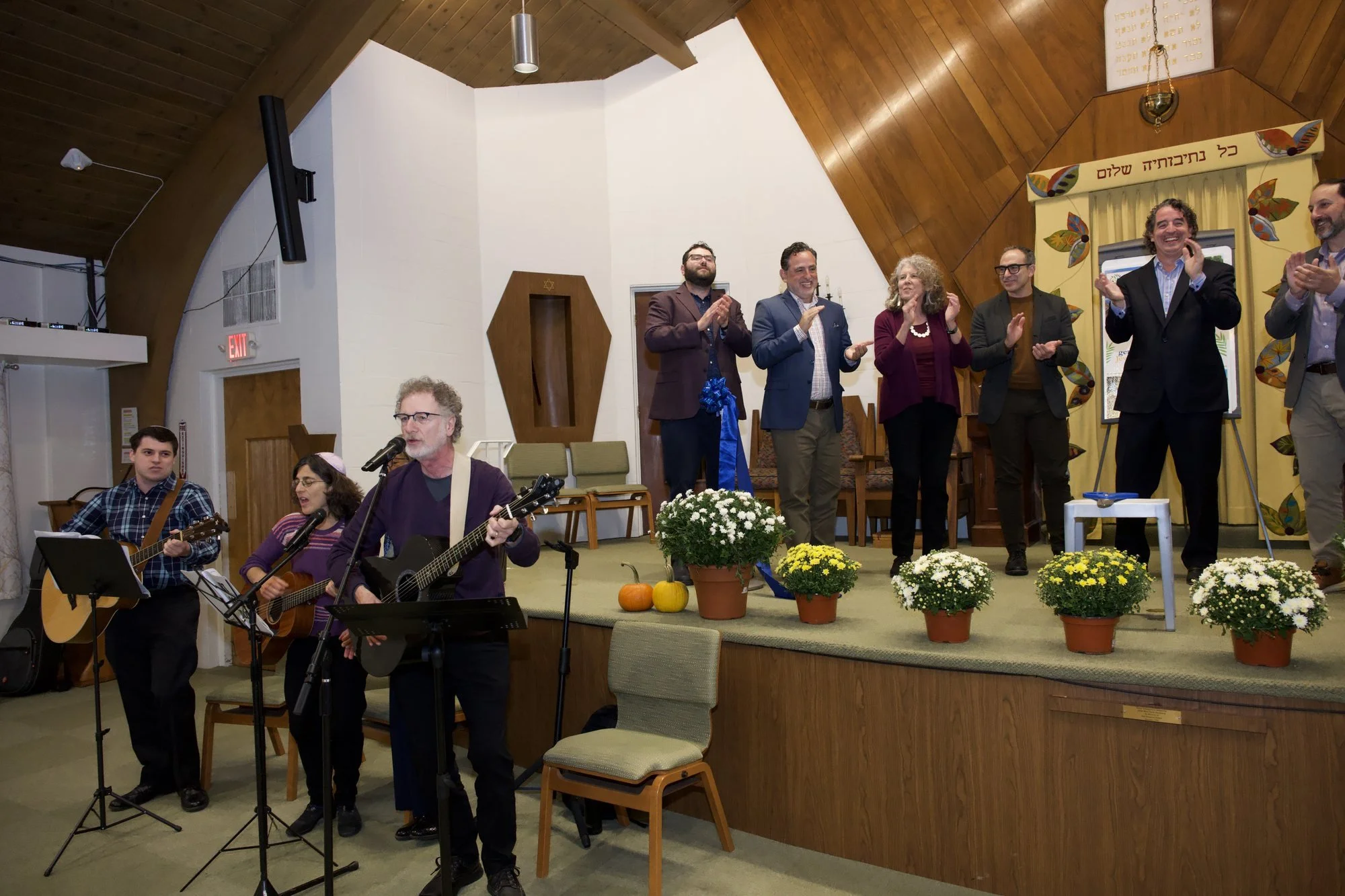
Full description: Members of the HBT band, from right Cantor Jeff Klepper, Sharin Horvitz-Chung and Noah Simon, play and sing in front of the bimah, while on the bimah behind them the speakers clap along: Noah Weinberg, Michael Kadish, Rabbi Emerita Barbara Penzner, Mark Wilen, Jason Arenburg, laughing, and Councilor Benjamin Weber. Pots of mums and small pumpkins line the edge of the stage.
The celebration didn’t end when the ribbon was cut. Rabbi Aliza welcomed Shabbat and Sukkot with candles, wine in a Sukkot melody, and a Shehecheyanu for arriving at this moment with our new roof. (With the storm keeping us inside, we skipped the blessing for sitting in the sukkah and hoped for dessert out there later.) Then she asked us to come close and connect to someone connected to the challah, “energetically or physically.” That was the whole evening in one picture. The bread comes from the earth, and the earth’s harvest grows from the same sunlight our roof now gathers. “Turn! Turn! Turn!”, with its words from Kohelet, the book we read on Sukkot, sent us downstairs to dinner.
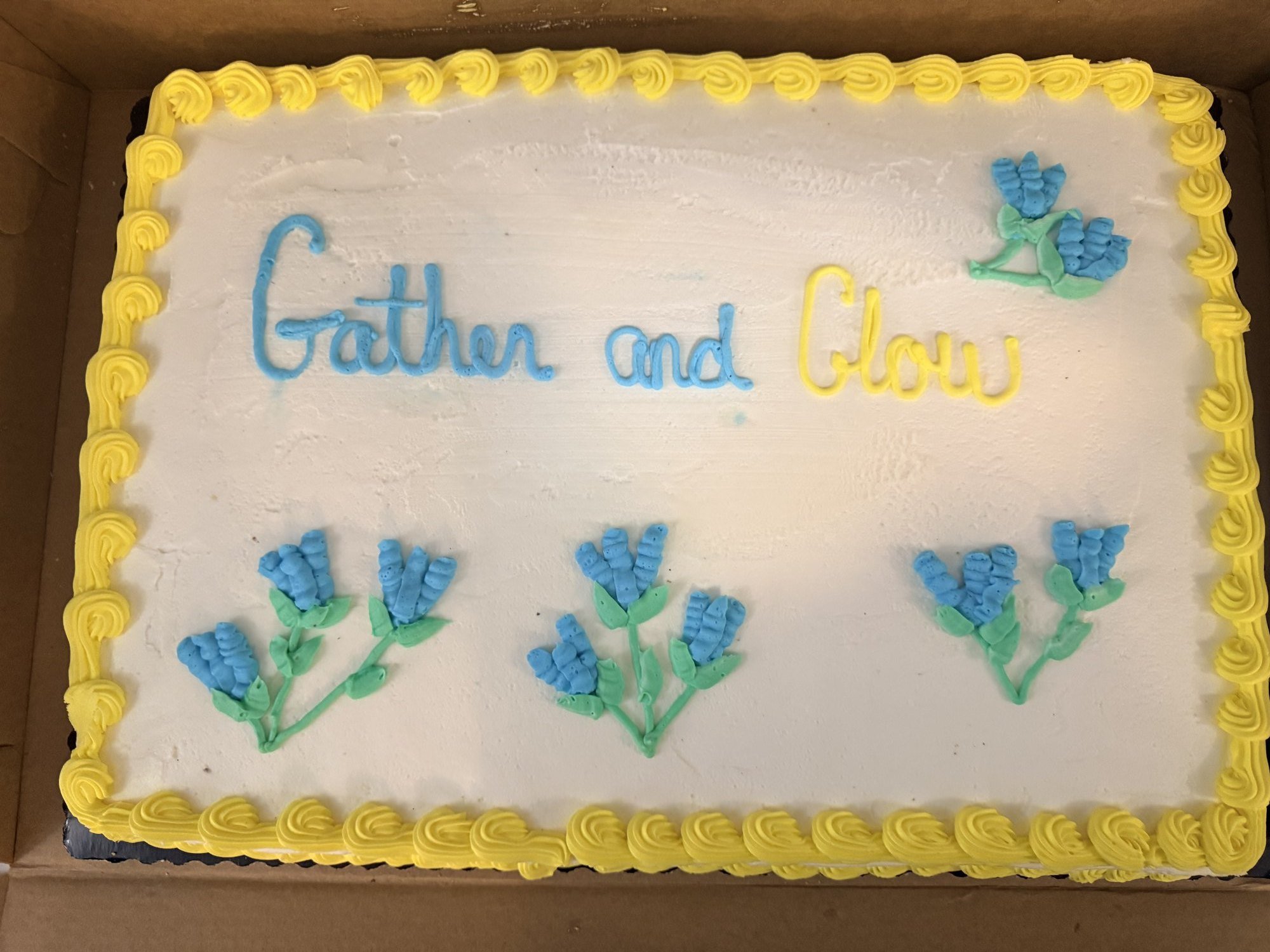
Full description: A white sheet cake in its box, edged all around with piped yellow frosting. Across the top, in flowing icing script, it reads “Gather and Glow,” with “Gather and” in blue and “Glow” in yellow. Below the words, three clusters of blue piped flowers on green stems run across the cake, and one more cluster sits in the upper corner.
Many hands
Rabbi Aliza thanked Jason for his “moral leadership”: he brought the idea to a board meeting, stayed with the research, and stood in the parking lot during construction. She thanked our fundraising co-chairs, Rahel Gruenberg and Raquel Rosenblatt, fondly known as “R-squared,” and Jessica Williamson, a central planner of the evening. Our thanks also go to the fundraising committee, the board, the HBT band (Cantor Jeff Klepper, Susannah Sirkin, Sharin Horvitz-Chung and Noah Simon), and every one of the 89 households who gave. National partners matter, but a project like this happens because particular people research, raise money, solve problems and show up.
Looking ahead
Sukkot, our solar anniversary
From this year on, Sukkot is also the anniversary of our solar panels. It’s a fitting pair. Sukkot is the festival of shelter and harvest, and our new roof now does both: it shelters us, and it harvests the sun.
Every fall, as we build the sukkah and remember how fragile shelter can be, we can look up at the roof that shelters us and powers us, and give thanks for both. Next Sukkot brings our first full year of real production numbers, and we’ll share them.
As members of Adamah’s coalition, we’ll name a climate liaison and file a Climate Action Plan before Tu B’Shvat. And the sanctuary is still waiting for its turn to go electric. The work isn’t finished, and that’s part of the good news.
The full solar project story Support the solar project

With gratitude to our matching funder, the Jewish Solar Challenge, project of the Schwartz-Rosman Foundation.
Founded in 2021, Jewish Solar Challenge facilitates the fiscal and energy sustainability of Jewish community institutions through matching grants, education, and advocacy. Jewish Solar Challenge is a fiscally sponsored project of the Schwartz-Rosman Foundation.
Photos by Leon Bethune and Rahel Gruenberg.